Video Streaming System Architecture
Date: 2025-07-04
Status: Accepted
Authors: Canh
Deciders: canh-labs
Supersedes: -
Superseded-by: -
Context and Problem Statement
We are building a video streaming system where users can browse and watch videos on demand. The system must handle streaming efficiently, support video metadata management, in-memory caching, background download jobs, and telemetry for monitoring.
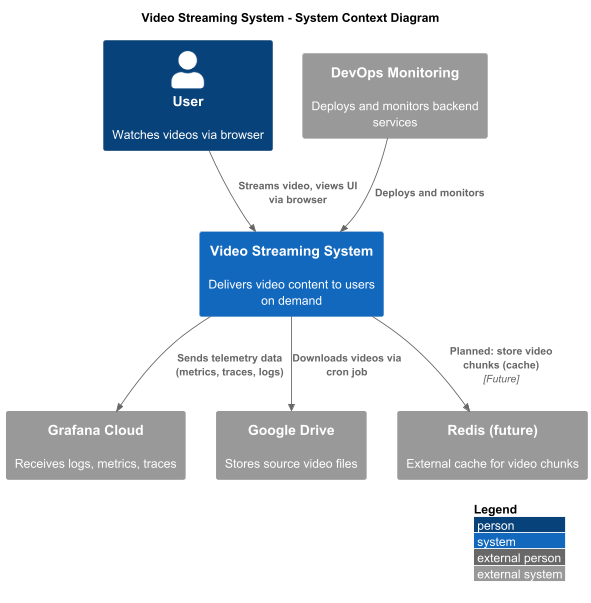
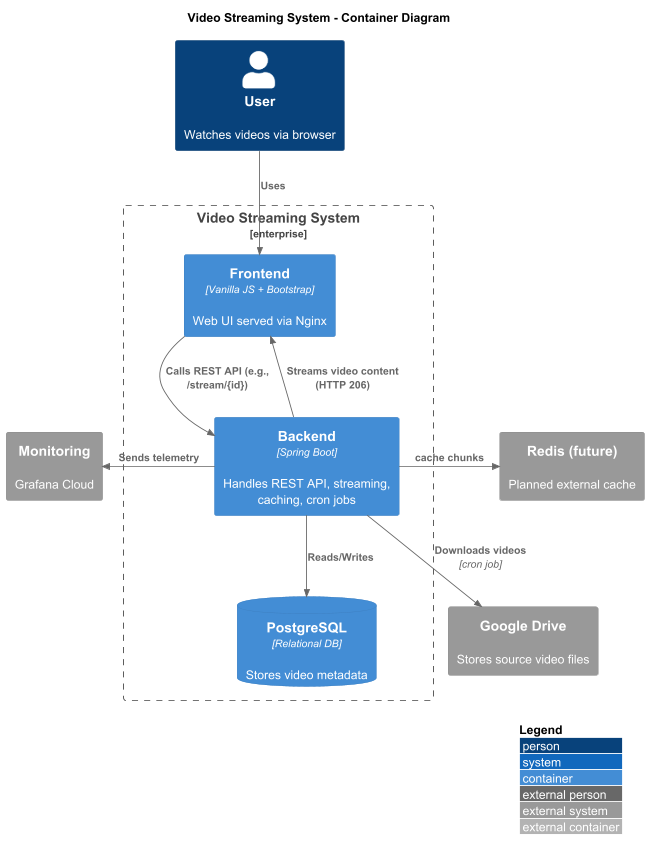
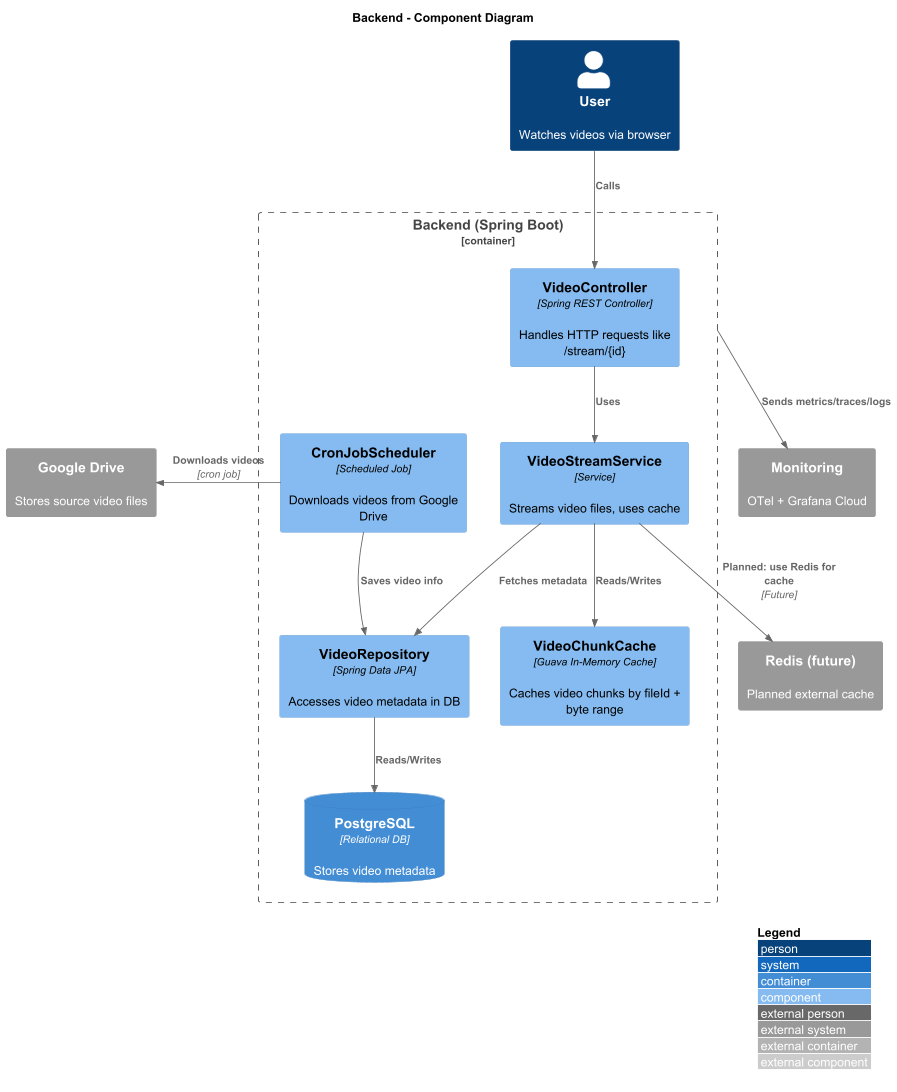
We adopt the C4 Model to document our software architecture in 3 levels: System Context, Container, and Component (for Backend).
Decision Drivers
- Efficient video streaming with support for chunked responses
- Clear separation between frontend/backend/database
- Future-proof design with Redis integration and observability
- Developer onboarding and system clarity
Considered Options
- Express + Node.js (not chosen)
- Monolithic Spring Boot with embedded Tomcat and Virtual Threads ✅
- CDN-based architecture (planned in future)
Decision Outcome
Adopt Spring Boot monolith with clearly defined layers and caching mechanism, and monitor it via OpenTelemetry and Grafana Cloud.
Architecture Overview (C4 Model)
Level 1 - System Context
Level 2 - Container Diagram
Level 3 - Component Diagram (Backend)
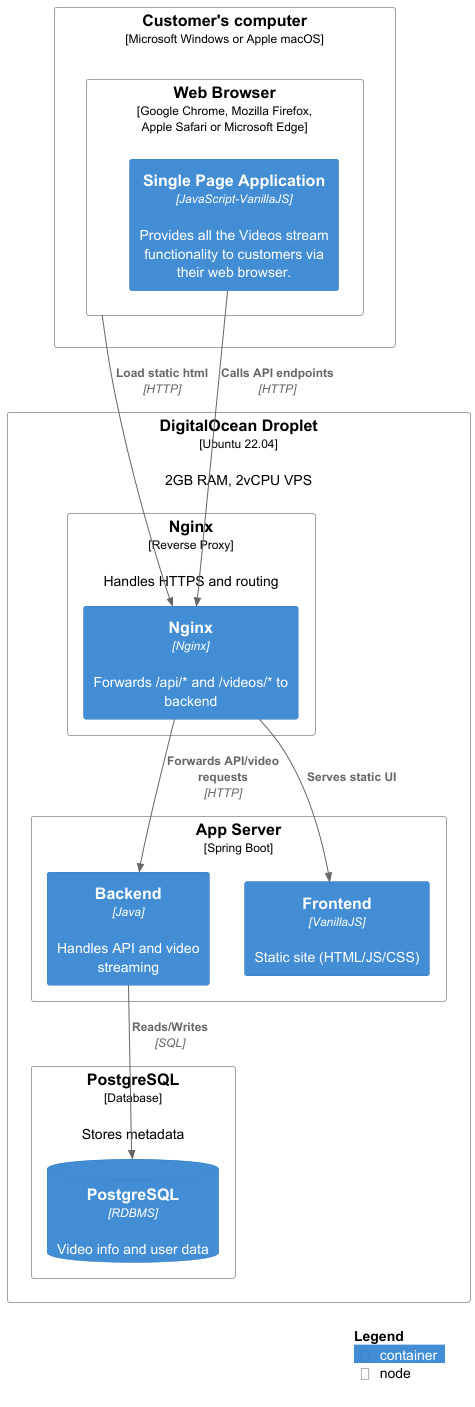
Deployment Diagram
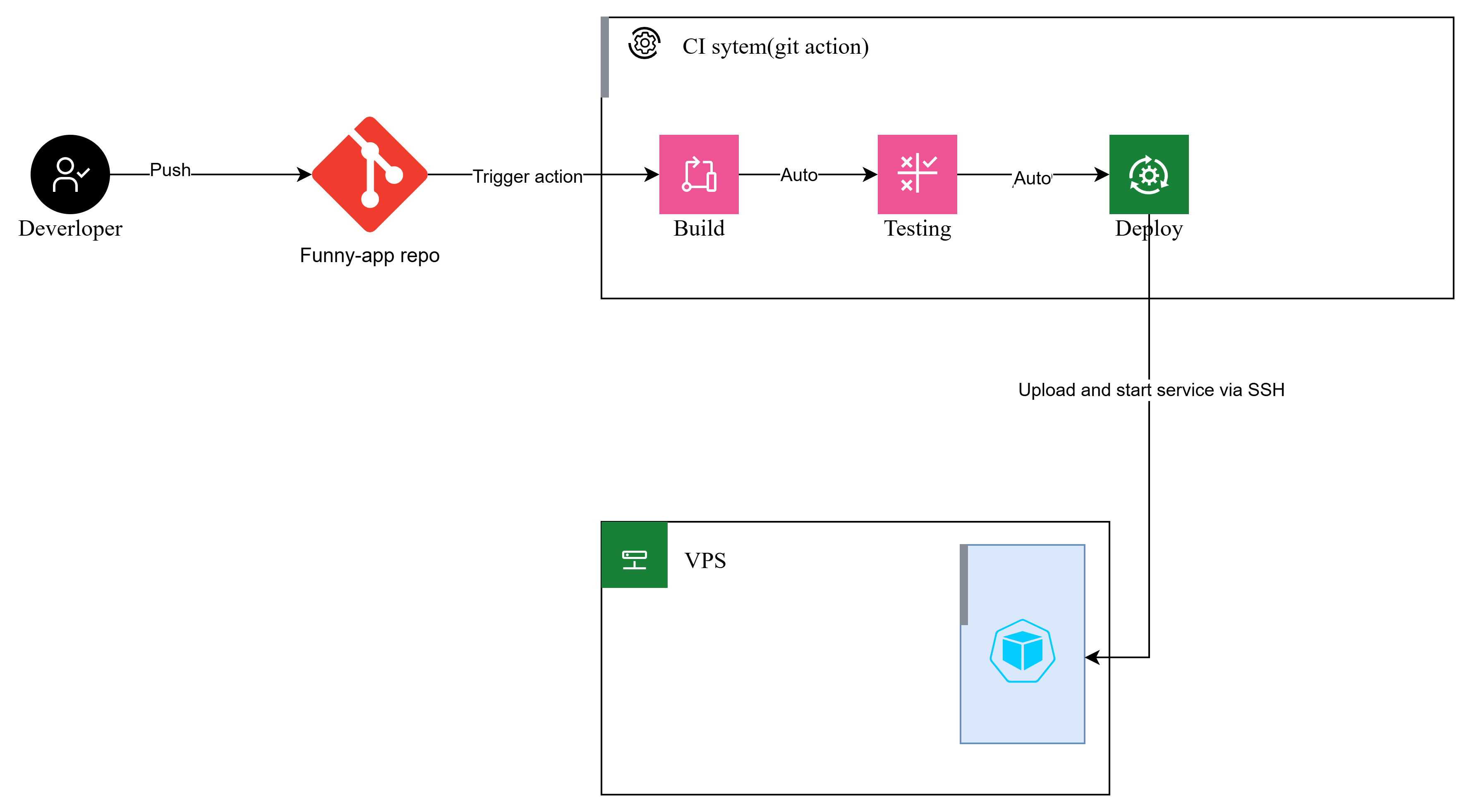
Deployment process (Current CICD)
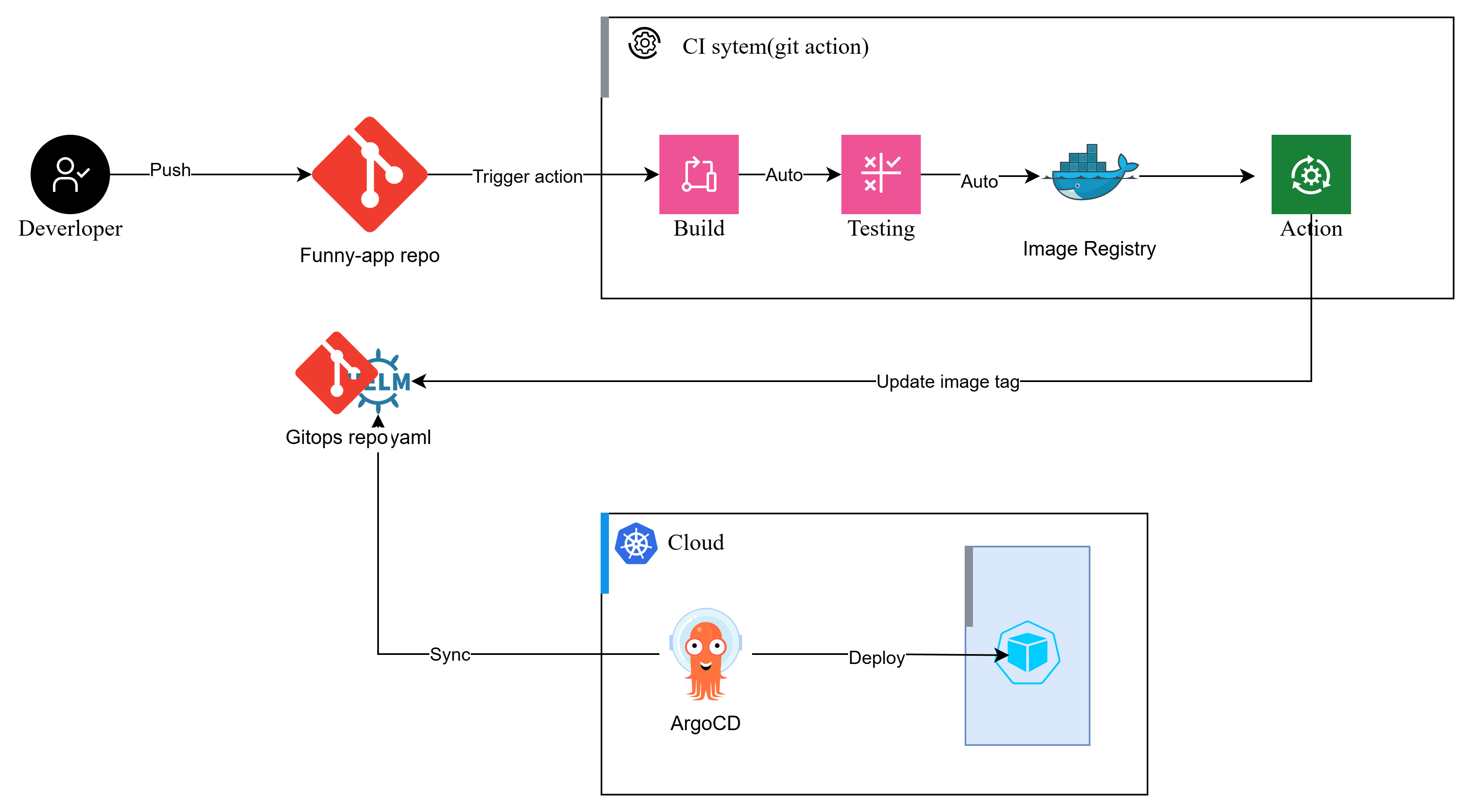
Gitops Continuous Deployment Process (Future improvement)
Consequences
- Easy to scale the backend horizontally
- Clear layering improves maintainability
- Video chunk caching can be switched from Guava to Redis later
- Monitoring is decoupled and aligned with observability standards
✨ Optimizations
- ✅ Uses virtual threads for controller to handle concurrent streams efficiently
- ✅ Uses Guava cache abstraction to allow future swap to Redis
- ✅ OTEL-compatible tracing enabled via agent
.jarandWithSpanon service methods - ✅ Metrics collected via
CacheStatsServicefor total hits, misses, and per-file stats
Future Improvements
- Switch to HLS or DASH for adaptive bitrate
- Upload background jobs to warm cache by pre-fetching popular videos
- Support Redis-based distributed cache with same
AppCacheabstraction - Use async Netty-based streaming for ultimate IO scalability
Notes
- Virtual Threads are used in Backend for efficient streaming
- In-memory cache with Guava used until Redis is integrated
- CronJob handles background downloading and database update
Architecture Decision Records (ADR)
The following ADRs record the key decisions made for this system. Each links to the full decision document including context, options considered, and consequences.
| ADR | Title | Status |
|---|---|---|
| ADR-0001 | Use Relational Database (PostgreSQL) for Core Data | Accepted |
| ADR-0002 | Use Layered Spring Boot Architecture with Virtual Threads | Accepted |
| ADR-0003 | Use Guava Cache Initially, with Planned Migration to Redis | Accepted |
| ADR-0004 | Use Vanilla JS + Bootstrap with Planned Migration to React | Accepted |
| ADR-0005 | Use LRU Cache for Video Streaming | Accepted |
| ADR-0006 | Switch to HLS for Local Video Streaming | Proposed |
| ADR-0007 | Admin Dashboard — Content & Account Management | Accepted |
| ADR-0008 | Migrate Frontend to React with Vite | Proposed |
| ADR-0009 | Unified Video List API for UI Display | Proposed |
| ADR-0010 | Add Trivy Dependency & Filesystem Scanning to CI | Accepted |
| ADR-0011 | Hot Video Priority Scoring | Accepted |
Decision Map
The diagram below shows how the ADRs relate to each architectural layer:
graph TD
    subgraph "Data Layer"
        ADR1[ADR-0001<br/>PostgreSQL]
    end

    subgraph "Backend"
        ADR2[ADR-0002<br/>Spring Boot + Virtual Threads]
        ADR3[ADR-0003<br/>Guava Cache → Redis]
        ADR5[ADR-0005<br/>LRU Cache for Streaming]
        ADR6[ADR-0006<br/>HLS Streaming]
        ADR7[ADR-0007<br/>Admin Dashboard]
        ADR10[ADR-0010<br/>Trivy CI Scanning]
    end

    subgraph "Frontend"
        ADR4[ADR-0004<br/>Vanilla JS → React]
        ADR8[ADR-0008<br/>React + Vite Migration]
        ADR9[ADR-0009<br/>Unified Video List API]
    end

    ADR2 --> ADR1
    ADR3 --> ADR2
    ADR5 --> ADR3
    ADR6 --> ADR5
    ADR7 --> ADR2
    ADR8 --> ADR4
    ADR9 --> ADR8
    ADR10 --> ADR2